
What Is the 30 60 90 Rule for Car Maintenance in Springfield, OH?
Discover More On:
If you have ever wondered whether your car is actually due for service or if you can safely wait a little longer, the 30 60 90 rule for car maintenance gives you a simple way to think about it. Instead of guessing, you use major mileage checkpoints to plan inspections, fluid service, and replacement of wear items before they turn into bigger problems.
At Zima Automotive, that kind of maintenance-first approach matters because many drivers here depend on their vehicles every day for commuting, errands, and long runs on busy local roads.
What Is the 30 60 90 Rule for Car Maintenance?
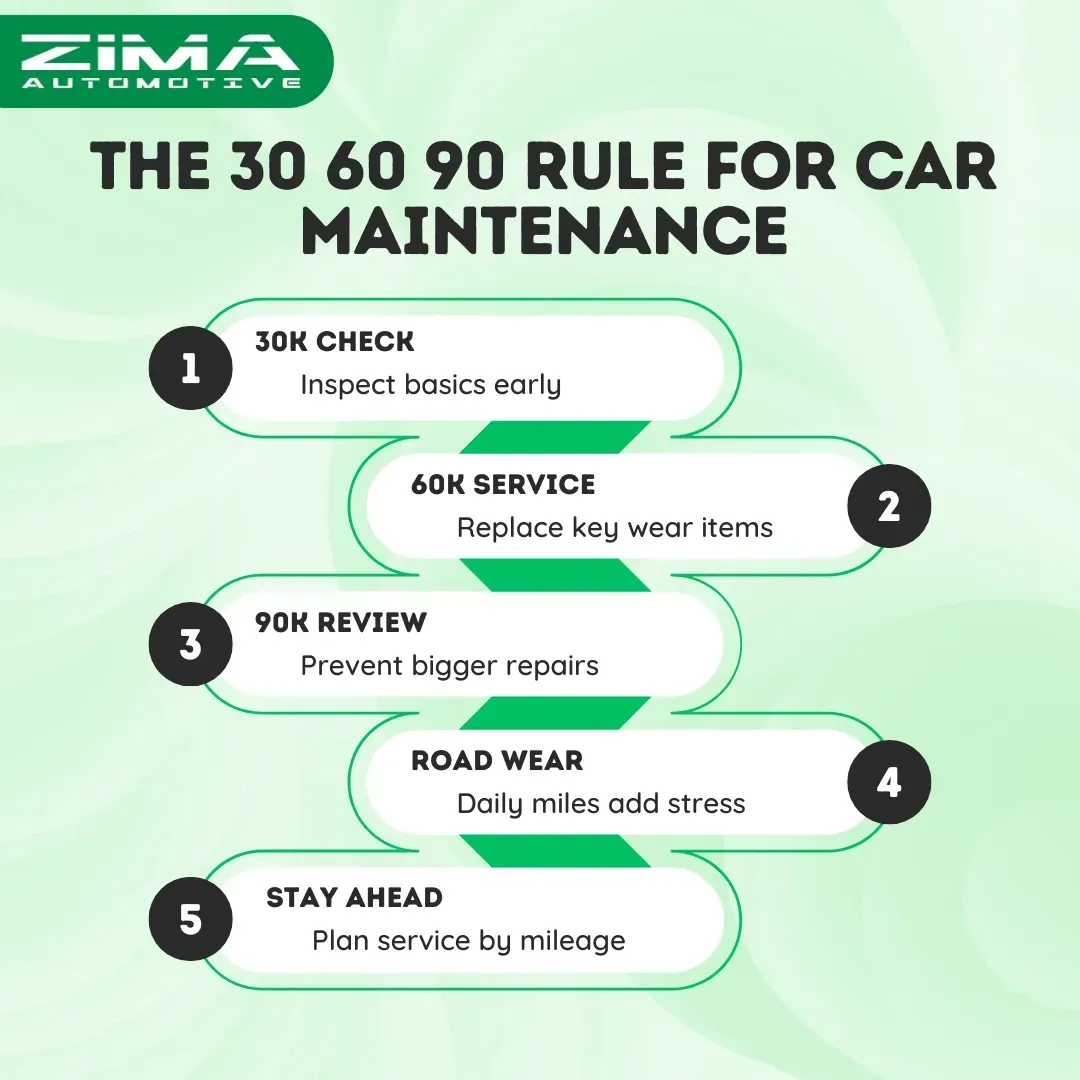
The idea is straightforward. Every 30,000 miles, your vehicle reaches a point where certain parts, fluids, and systems deserve a closer look. Some items may only need inspection at 30,000 miles, while others may need replacement by 60,000 or 90,000 depending on your make, model, mileage, and driving habits.
Why mileage milestones matter more than guesswork
Oil changes happen more often, but these larger checkpoints help you stay ahead of the kind of wear that sneaks up on people. A good car maintenance schedule Springfield, OH drivers can follow should account for brake wear, suspension stress, tire condition, fluid quality, filters, belts, and battery health. It is less about a rigid formula and more about using mileage as a reminder to inspect the systems that keep your car dependable.
What Should Be Checked Around 30,000 Miles?
At 30,000 miles, most vehicles are still in a good place overall, but small maintenance items start to matter more. This is often the best time to catch uneven tire wear, dirty filters, fluid condition issues, and early brake or suspension wear.
Fluids, filters, tires, and brake inspections
A 30,000-mile visit usually includes an inspection of your brakes, tires, battery, belts, hoses, and steering and suspension components. You may also need cabin and engine air filters, a tire rotation, an alignment check, and a close look at fluid levels and fluid condition. This is also where simple habits start paying off. One of the best car maintenance tips Springfield, OH drivers can follow is to stop treating every service visit like it is just an oil change. If your car sees daily stop and go driving, short trips, or regular highway miles, a basic inspection can reveal problems while they are still affordable to fix.
What Changes Around 60,000 Miles?
By 60,000 miles, maintenance becomes more serious. This is where wear starts showing up in ways you can feel, even if no warning light is on yet. Your car may still drive fine, but fluids may be breaking down, and key components may be aging out.
Wear items and system checks that affect reliability
A proper 30k 60k 90k service at this stage often includes more in-depth fluid service, spark plug replacement on many vehicles, brake inspection, cooling system review, and a closer check of suspension and steering parts. Depending on the vehicle, transmission service may also be recommended.
This is where preventive maintenance Springfield, OH really matters. Many local drivers are trying to keep an older vehicle on the road, not replace it. Spending money on planned service at 60,000 miles is usually a lot easier than dealing with overheating, poor fuel economy, rough running, or a transmission issue later.
Why 90,000 Miles Is a Big Turning Point
At 90,000 miles, your vehicle has built up enough real-world wear that neglected maintenance can turn expensive fast. This does not mean every car is in trouble at 90,000 miles. It means the margin for ignoring problems gets smaller.
Catching expensive problems before they grow
This checkpoint is often where shops look closely at belts, cooling system parts, suspension components, ignition parts, fluid condition, and leak points. If a vehicle has been maintained consistently, 90,000 miles can feel routine. If service has been delayed, this is often where the repair list starts stacking up. That is why the 30 60 90 rule for car maintenance works so well. It helps you spread maintenance out over time instead of waiting until the vehicle forces the issue. For many drivers, that means fewer surprises and a longer service life.
Why Springfield Driving Makes Routine Maintenance More Important
Mileage matters everywhere, but local driving habits still shape how parts wear out. Around Springfield, many vehicles are used hard and kept for the long haul, which makes scheduled maintenance even more valuable.
Work commutes, older vehicles, and daily wear
Daily driving on routes around Urbana Road and the I-70 corridor can add steady wear through stop and go traffic, longer commutes, and heavier use from trucks, vans, and family vehicles. In a market where many drivers focus on keeping a reliable vehicle running for years, staying on top of inspections and fluid service makes a real difference. That is also why a car maintenance schedule Springfield, OH should feel practical, not generic. The right plan depends on how you drive, what you drive, and whether your car is already showing signs like vibration, weak braking, rough shifting, or uneven tire wear.
Get Trusted 30 60 90k Service Help from Zima Automotive
If you are due for a 30 60 90k service or you are not sure where your vehicle stands, Zima Automotive can help you sort out what needs attention now and what can wait. We provide diagnostics, maintenance, brake service, suspension checks, fluid services, and repair recommendations built around real vehicle condition, not pressure.
Visit us at 4800 Urbana Rd, Springfield, OH 45502 or call (937) 342-3911 to schedule a maintenance check. If your goal is to keep your car reliable without overspending, our team can help you build a smart plan around the 30 60 90 rule for car maintenance.
Frequently Asked Questions
Is the 30 60 90 rule the same for every vehicle?
No. It is a helpful rule of thumb, not a one-size-fits-all checklist. Your manufacturer schedule still matters, and some vehicles need certain services sooner or later depending on engine design, fluid type, and driving conditions.
What is usually included in a 30 60 90k service?
That depends on the vehicle, but it usually includes inspections, fluid checks, filter replacement, brake and tire evaluation, and mileage-based service recommendations. As mileage climbs, it may also include spark plugs, transmission service, cooling system work, and replacement of worn parts before they fail.
Can I wait if my car still feels fine?
You can, but that is where costs often go up. Many maintenance-related issues do not affect drivability right away, so by the time you feel a problem, the repair may be bigger than it needed to be.
How do I know what my car actually needs right now?
The best starting point is an inspection tied to your mileage, service history, and current symptoms. That gives you a more useful answer than guessing based on age alone or waiting for a warning light to tell you something is wrong.
Takeaways
The 30 60 90 rule works because it gives you a simple framework for staying ahead of wear before it turns into a breakdown. At 30,000 miles, you are checking the basics. At 60,000 miles, you are protecting reliability. At 90,000 miles, you are often preventing the kinds of repairs that cost far more when ignored. For local drivers, that matters even more. A vehicle that handles work commutes, daily errands, and regular highway miles needs more than occasional oil changes. A smart maintenance plan helps you keep the car you already own in better shape for longer.

Max Zima
Lorem ipsum dolor sit amet, consectetur adipiscing elit, sed do eiusmod tempor incididunt ut labore et dolore magna aliqua. Ut enim ad minim veniam, quis nostrud exercitation ullamco laboris nisi ut aliquip ex ea commodo consequat. Duis aute irure dolor in reprehenderit in voluptate velit esse cillum dolore eu fugiat nulla pariatur. Excepteur sint occaecat cupidatat non proident, sunt in culpa qui officia deserunt mollit anim id est laborum.
Lorem ipsum dolor sit amet, consectetur adipiscing elit, sed do eiusmod tempor incididunt ut labore et dolore magna aliqua. Ut enim ad minim veniam, quis nostrud exercitation ullamco laboris nisi ut aliquip ex ea commodo consequat. Duis aute irure dolor in reprehenderit in voluptate velit esse cillum dolore eu fugiat nulla pariatur. Excepteur sint occaecat cupidatat non proident, sunt in culpa qui officia deserunt mollit anim id est laborum.
Lorem ipsum dolor sit amet, consectetur adipiscing elit, sed do eiusmod tempor incididunt ut labore et dolore magna aliqua. Ut enim ad minim veniam, quis nostrud exercitation ullamco laboris nisi ut aliquip ex ea commodo consequat. Duis aute irure dolor in reprehenderit in voluptate velit esse cillum dolore eu fugiat nulla pariatur. Excepteur sint occaecat cupidatat non proident, sunt in culpa qui officia deserunt mollit anim id est laborum.
Discover More On:
